Why Your Friend's Shout-Out to Orion Sticks in Your Brain Better Than Any Star Chart
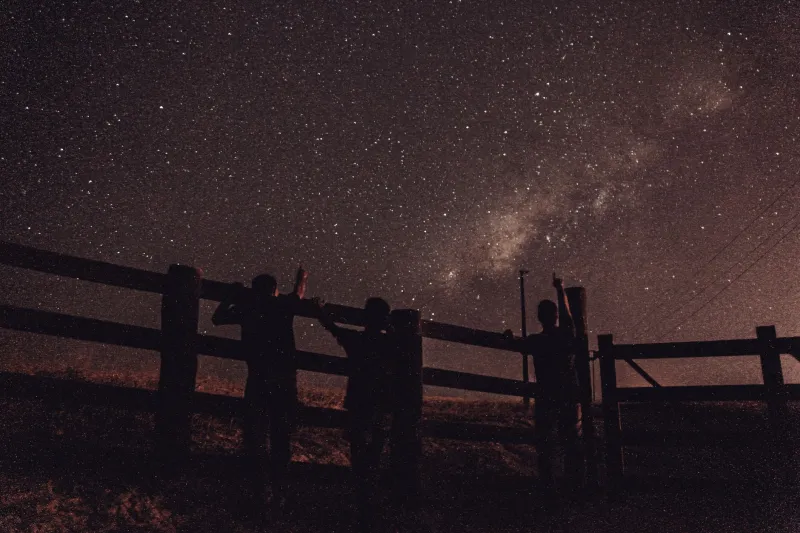
Picture this: you're out in a field somewhere in rural Pennsylvania, three layers deep in fleece, squinting at a sky you've been studying for weeks. You've got your star chart. You've done the homework. And then your buddy Marcus throws an arm over your shoulder, points up, and goes, "There—see that W shape? That's Cassiopeia."
And you never forget it.
You could've found it yourself. You were this close. But something about Marcus saying it first made it stick in a way no amount of solo prep ever quite managed. That's not a coincidence. That's your brain doing something genuinely interesting—and understanding it might be the best upgrade you can make to your stargazing sessions this year.
What Happens in Your Brain When Someone Else Makes the Discovery
Cognitive psychologists have spent decades studying what's called social learning—the way humans absorb information differently depending on whether they encounter it alone or through another person. The short version? Information delivered in a social context tends to get flagged as more important by the brain.
Here's why. When you're studying a star chart solo, your brain is processing visual and spatial information in a fairly routine way. It's doing its job, but there's no particular signal telling it to treat this information as high-priority. When someone in your group suddenly identifies a constellation out loud, a few different things happen simultaneously.
First, your attention snaps to a specific point in the sky. Attention is the gatekeeper of memory—nothing gets stored well without it, and nothing commands it like an unexpected social cue. Second, your brain registers an emotional response: curiosity, maybe a little competitive spark, possibly the warm glow of shared discovery. Emotional context strengthens memory encoding. Third, you're now associating that constellation with a person, a moment, a specific night. That web of associations gives your brain multiple retrieval paths the next time you're looking for Cassiopeia.
Researchers call the broader principle socially shared cognition, and it's been documented across educational settings from classrooms to surgical training. The takeaway is consistent: we remember more when we learn alongside others.
The Attention Angle Nobody Talks About
There's another layer worth digging into, and it's specifically relevant to amateur astronomy: the phenomenon of joint attention.
Joint attention is what happens when two or more people deliberately focus on the same thing at the same time. It's one of the earliest cognitive skills humans develop—babies do it before they can talk—and it turns out to have lasting effects on how information is encoded throughout our lives.
In a stargazing context, joint attention is happening constantly. Someone calls out a meteor. Heads swivel. Everyone locks onto the same patch of sky. That shared focusing act, researchers suggest, creates a kind of collaborative spotlight that makes the target more memorable for everyone present—not just the person who spotted it first.
Solo stargazers miss out on this entirely. When you're alone with your star atlas, there's no external signal reinforcing what deserves your focus. Your attention drifts, priorities blur, and the learning that happens is shallower as a result.
Social Reinforcement: The Feedback Loop That Keeps Giving
There's also the simple matter of reinforcement. When Marcus points out Cassiopeia and you actually see it, you probably say something—"Oh wow, yeah!" or "Got it!"—and Marcus confirms you're looking at the right thing. That small exchange is doing real memory work.
Positive social reinforcement activates dopamine pathways, which play a direct role in consolidating long-term memories. The brief moment of connection—shared discovery, mutual confirmation—is neurologically meaningful. It's not just a nice feeling. It's a memory stamp.
This is part of why experienced astronomy club members often notice that newer observers who attend group sessions regularly seem to outpace solo learners at a striking rate. It's not just access to better equipment or more experienced guidance, though those help. It's that the social fabric of a club session creates dozens of these small reinforcement moments every single night.
Making This Work for Your Group
Knowing the science is one thing. Using it to run better stargazing nights is another. Here are a few practical ways to lean into the social memory effect during your next outing.
Rotate the "spotter" role. Rather than always letting the most experienced person in the group identify objects first, take turns. Assign someone to be the first caller for each part of the sky. Even when beginners are uncertain, the act of verbalizing a guess and getting group feedback creates strong encoding—for the guesser and the listeners.
Narrate what you're seeing. Encourage everyone to describe what they notice out loud, even if it feels awkward at first. "I'm seeing three stars in a row and then two more slightly above" is doing more memory work than silently confirming it on an app. The verbal articulation forces the brain to organize spatial information in a more durable way.
Build in a recap moment. At the end of the night, spend five minutes going around and having everyone name one thing they saw for the first time. This retrieval practice—recalling information in a social setting—is one of the most effective memory consolidation techniques known to cognitive science.
Let beginners lead. It sounds counterintuitive, but there's evidence that being the person who teaches something, even imperfectly, dramatically improves your own retention of that material. If a newer member thinks they've spotted Scorpius, let them walk the group through it before the veteran confirms or corrects. Everyone learns more.
The Bigger Picture
None of this means solo stargazing isn't worthwhile—it absolutely is. Quiet nights alone under the sky have their own irreplaceable value. But if you're trying to genuinely build your constellation knowledge, deepen your understanding of the sky, and make those hard-earned observations actually stick, the research is pretty clear: you need other people.
Astronomy has always been a communal pursuit at its heart. Ancient civilizations mapped the stars together. The great observatories of the 19th century were collaborative institutions. And your local club's Friday night sessions are, in their own way, continuing that tradition.
Your brain was built for this kind of shared discovery. The night sky is vast enough that there's always something new to find. The only question is who you're going to find it with.