More Than a Hobby: How Astronomy Clubs Are Quietly Improving Members' Mental Health
Marcus Rivera didn't join his local astronomy club because he was struggling. He joined because he wanted a better view of Jupiter. But six months into attending monthly star parties in the Texas Hill Country, something unexpected happened. "I realized I wasn't waking up at 3 a.m. with my mind racing anymore," he says. "I don't know exactly when it shifted, but the anxiety just... quieted down."
Marcus isn't alone in noticing this. Across astronomy clubs and stargazing groups in the US, members are reporting emotional and psychological changes that go far beyond the thrill of a good deep-sky object. And science is starting to catch up with what these amateur astronomers already know: there's something genuinely healing about watching the cosmos with other people.
What the Research Is Starting to Tell Us
Psychologists have long studied two separate phenomena — the mental health benefits of spending time in nature, and the wellbeing boost that comes from social belonging. Shared stargazing sits at the intersection of both, and that combination appears to be unusually powerful.
Research on "awe" as an emotional experience has grown significantly over the past decade. Studies out of institutions like UC Berkeley have found that awe — that overwhelming sense of smallness in the face of something vast — measurably reduces stress hormones, decreases self-focused rumination, and promotes pro-social behavior. The night sky, with its sheer scale and ancient light, is one of the most reliable awe triggers humans have access to.
But here's what makes the community element so important: awe experienced alongside other people tends to be more intense and more memorable than awe experienced alone. When you gasp at a meteor streaking across the sky and someone next to you gasps too, the emotional resonance amplifies. You're not just witnessing something extraordinary — you're sharing it, and that sharing does something to the brain that solo observation simply can't replicate.
Add to that the well-documented mental health benefits of social connection — reduced risk of depression, lower perceived stress, greater sense of purpose — and you've got a hobby that's quietly functioning as a form of community therapy.
"I Didn't Realize How Isolated I'd Become"
Denise Cho, a software developer in the Pacific Northwest, started attending her astronomy club's monthly meetups after a friend dragged her along two years ago. She describes her life before that as "fine, but gray."
"I was working remotely, living alone, doing all the things you're supposed to do for self-care — exercise, good sleep, eating well," she says. "But I was still just kind of... flat. I didn't have a reason to leave the house that felt meaningful."
After a few months with the club, that flatness started to lift. "It wasn't any one thing. It was showing up somewhere people actually expected me. It was learning someone's name and then looking forward to seeing them again. It was caring about whether the weather would be clear on Saturday."
What Denise is describing maps closely onto what social scientists call "weak ties" — relationships that aren't close friendships but still provide a meaningful sense of connection and community. Research consistently shows that weak ties contribute significantly to life satisfaction, and astronomy clubs are remarkably good at generating them. You don't have to be best friends with everyone at a star party. You just have to show up, share a eyepiece view of the Orion Nebula, and talk about what you're seeing.
The Ritual of Showing Up
There's also something to be said for the rhythm of regular participation. Most astronomy clubs operate on predictable schedules — monthly meetings, seasonal star parties, annual events tied to major celestial happenings. That predictability creates structure, and structure is something mental health professionals frequently recommend for people dealing with anxiety or depression.
"I know that on the second Saturday of every month, I have somewhere to be," says Tom Greer, a retired high school teacher from Ohio who joined his regional astronomy club three years ago after his wife passed away. "Grief messes with your sense of time. Everything feels shapeless. Having that anchor — knowing the club is meeting, knowing people will ask how I'm doing — it helped me more than I can explain."
Tom's experience highlights another dimension that often goes unspoken in discussions about hobby communities: the way they provide low-pressure social support during difficult life transitions. Nobody at the star party is going to ask you to process your feelings out loud. But they'll hand you a star chart, show you where to point your scope, and stand next to you in the dark for a few hours. Sometimes that's exactly what's needed.
Getting Outside Matters More Than You Think
It's easy to overlook the physical dimension of stargazing, but it matters. Most serious observation happens outdoors, often in locations with minimal light pollution — parks, rural fields, mountain clearings. Getting to these places usually means some amount of walking, fresh air, and time away from screens.
Environmental psychology research has consistently shown that time spent in natural settings reduces cortisol levels and activates the parasympathetic nervous system — the body's "rest and digest" mode, as opposed to the stress-driven "fight or flight" response. Even a couple of hours under a dark sky can shift your body into a calmer physiological state.
When you're doing that alongside a group of people who share your enthusiasm, the effect compounds. You're not just out in nature — you're out in nature with a sense of purpose and belonging. That's a genuinely different experience than a solo walk in the park, and the mental health payoff reflects it.
How to Find Your People
If any of this resonates with you, the good news is that astronomy clubs exist in almost every corner of the country. The Astronomical League maintains a directory of affiliated clubs across all 50 states, and most are welcoming to complete beginners. Many host free public nights where you can show up with zero equipment and still spend a couple of hours looking through member telescopes.
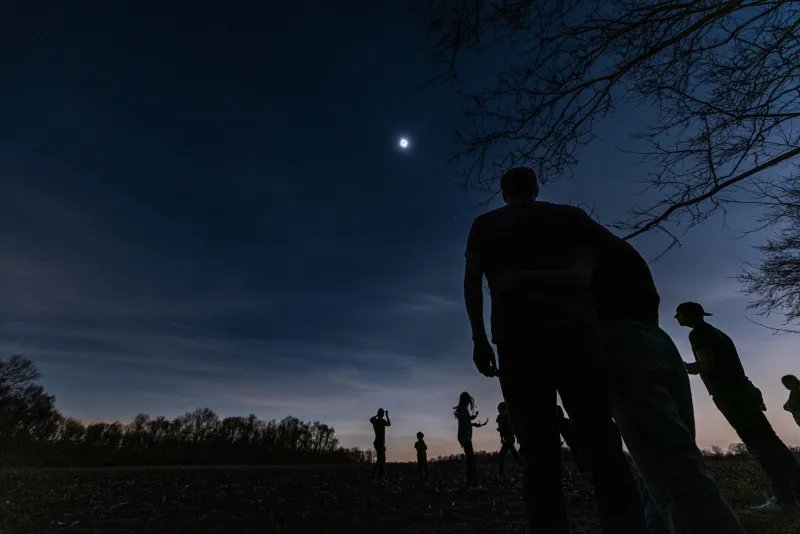
You don't need to commit to anything on your first visit. Just go. See how it feels to stand in the dark with a group of people who are all craning their necks at the same patch of sky. Notice whether something in you settles a little.
For Marcus Rivera, the guy who came for Jupiter and stayed for his mental health, the advice is simple. "Just keep showing up," he says. "The sky will do its part. The people will do theirs. And somewhere in the middle of all that darkness, you'll find something that makes you feel a lot less alone."
The stars have been doing this for humans for thousands of years — giving us something enormous to contemplate together. It turns out that's still exactly what a lot of us need.