Why Stargazing With a Friend Literally Changes How Your Brain Remembers the Night Sky
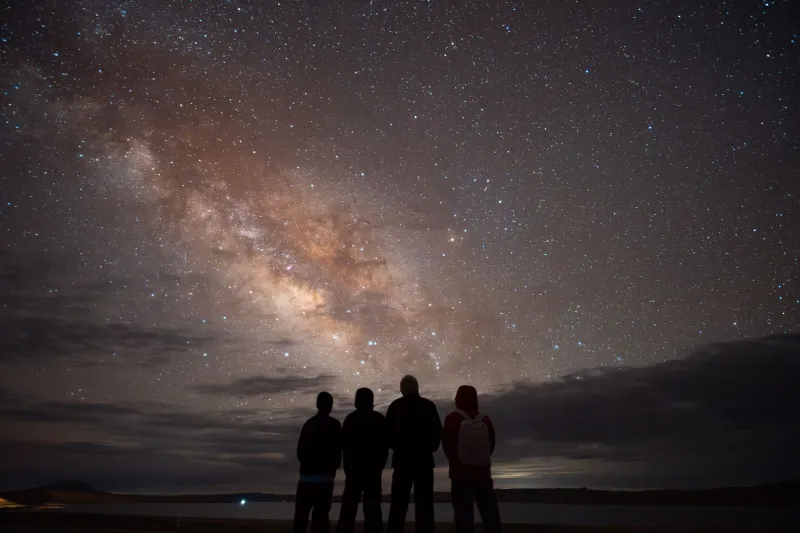
Think back to the most memorable night you've ever spent under the stars. Chances are, you weren't alone.
Maybe it was the Perseid meteor shower on a camping trip with old college friends. Maybe it was a local star party where a stranger pointed out Saturn's rings through their telescope and you actually gasped out loud. Whatever the scene, there's probably at least one other person in the frame — and that's not a coincidence.
Research into memory, social cognition, and shared experience is starting to explain something astronomy enthusiasts have felt for years: the night sky just hits different when someone else is looking at it with you.
Your Brain on Shared Experience
Neuroscientists have long known that emotionally charged events get encoded more deeply in memory than routine ones. The amygdala — your brain's emotional processing hub — essentially flags certain moments as "worth keeping," and those memories get consolidated more thoroughly during sleep. Strong emotion equals stronger recall. That part most people already know.
What's less widely understood is how social context supercharges that process.
When you experience something alongside another person, your brain doesn't just process the event itself. It also processes the other person's reaction, the verbal exchange that follows, the shared language you use to describe what you're seeing. Dr. Thalia Wheatley, a social neuroscience researcher at Dartmouth, has described this as "neural coupling" — the way our brains actually synchronize during shared experiences, creating a kind of cognitive resonance that amplifies encoding.
In plain terms: when you and a friend both watch a meteor streak across Orion and one of you says "did you see that?" — that moment gets burned into memory in a way a solo sighting almost never does.
The Role of Language in Locking In the Sky
Here's something stargazers don't always think about: naming things helps you remember them.
When you're out alone, you might spot a fuzzy patch in Perseus and move on. But when you're with someone else, you're far more likely to stop, talk about it, look it up, and give it a name — the Double Cluster, as it turns out, one of the most beautiful open cluster pairs in the northern sky. That verbal encoding creates a second memory trace, separate from the visual one, and the two reinforce each other.
This is sometimes called the "generation effect" in memory research — the idea that information you actively produce (by saying it, writing it, explaining it) is retained far better than information you passively receive. Group stargazing is basically a continuous generation-effect exercise. You're constantly describing, questioning, debating, and narrating the sky. Every conversation is a memory anchor.
Long-time members of astronomy clubs across the country will back this up without needing to cite a single study.
"I've been doing this for almost twenty years," says one member of a regional astronomy club in the Midwest who has attended hundreds of observation nights. "I can barely remember what I saw solo last month. But I can describe, in detail, the night our whole group watched Jupiter occult a star back in 2012. I remember who was standing next to me. I remember what someone said when it happened. It's just there."
Emotion Is Contagious — and That's a Good Thing
One of the underrated dynamics of group stargazing is emotional contagion. When someone in your group loses their mind over a globular cluster or tears up during a total lunar eclipse, that emotional response spreads. It's not manufactured — it's neurological. Humans are wired to mirror each other's emotional states, and in a dark field under a brilliant sky, that mirroring can turn an already beautiful moment into something genuinely transcendent.
This is part of why first-time stargazers who learn in a group setting tend to fall harder for astronomy than those who start alone. The awe is amplified. The wonder gets socially validated. And validated wonder has a much longer shelf life.
"I brought my daughter to a star party when she was nine," recalls a member of an astronomy group in the Pacific Northwest. "She saw a comet for the first time through a twelve-inch Dobsonian. But what she still talks about — fifteen years later — isn't just the comet. It's the guy who let her look, and how excited he was to show her. That energy was part of the memory."
The Forgetting Curve Problem — and How Community Solves It
Hermann Ebbinghaus, the German psychologist who mapped out how memory decays over time, found that we forget roughly half of new information within an hour of learning it — and up to 90% within a week, without reinforcement. Astronomers who study solo face this problem constantly. You see something incredible, you have no one to talk to about it, and within days the details blur.
Group observation naturally combats this. Post-session conversations, shared photos, group chats, and club newsletters all serve as spaced retrieval practice — one of the most evidence-backed memory consolidation techniques in cognitive psychology. Every time someone in your group mentions "remember that night the seeing was perfect and we split the Double Double in Lyra?" you're re-activating and strengthening that memory trace.
This is one reason astronomy clubs have always had a culture of storytelling. It's not just social bonding — it's accidental memory maintenance.
What This Means for Your Stargazing Practice
None of this means solo stargazing isn't valuable. Quiet nights alone under the Milky Way have their own kind of depth, and plenty of serious observers cherish that solitude. But if you want the night sky to stay with you — if you want to build a rich, detailed, emotionally resonant relationship with astronomy over time — the science suggests that community is one of your most powerful tools.
Bring a friend to your next observation session. Join a local astronomy club. Show up to a star party even if you don't have a telescope. Let yourself get caught up in someone else's excitement about a galaxy you've already seen a dozen times.
Your brain will thank you. And years from now, when someone asks about your most unforgettable night under the stars, there's a very good chance another person will be part of the answer.
Looking for astronomy friends to share the sky with? Check out our community resources and find a star party or club near you.