Backyard Telescopes, Real Science: How Amateur Astronomers Are Changing What We Know About Space
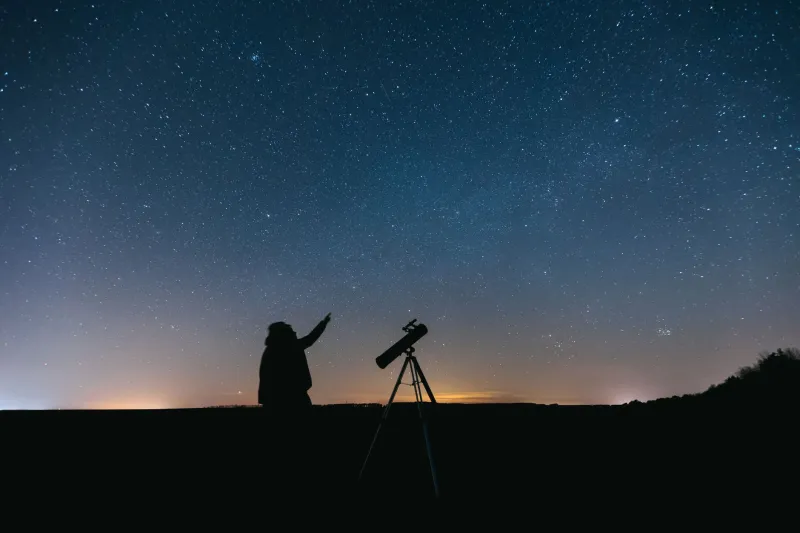
There's a moment every stargazer knows — the one where you're out in the yard, eye pressed to the eyepiece, and something clicks. Maybe it's Saturn's rings coming into focus for the first time, or a fuzzy smudge that turns out to be a galaxy millions of light-years away. It feels personal, almost private. But here's the thing: that moment, and the observations that follow it, might actually matter to science in a very real way.
Citizen astronomy — the practice of amateur observers contributing usable data to legitimate scientific research — has quietly become one of the most exciting developments in modern space science. And the community of backyard stargazers doing this kind of work is growing fast.
More Than Just a Hobby
For a long time, the line between amateur and professional astronomy was pretty clear. Professionals had the big equipment, the university affiliations, and the peer-reviewed journals. Amateurs had passion, clear skies (hopefully), and maybe a decent Dobsonian. The two worlds occasionally overlapped, but real discovery? That was mostly left to the pros.
That divide has been shrinking for years, and today it's nearly gone in some fields. The reason comes down to a few key shifts: better consumer-grade equipment, open-access data platforms, and the sheer scale of what professional observatories need to cover. The universe is a big place. There aren't enough professional eyes — or telescopes — to watch all of it.
That's where the astronomy community comes in.
Exoplanet Hunting From Your Driveway
One of the most remarkable examples of citizen science in action is exoplanet detection. NASA's TESS mission (Transiting Exoplanet Survey Satellite) generates enormous amounts of light-curve data — graphs showing how a star's brightness changes over time. When a planet passes in front of its star, it causes a tiny, measurable dip in that brightness. The problem? TESS produces more data than any small team of scientists can realistically analyze.
Enter the Planet Hunters TESS project, run through the Zooniverse platform. Volunteers — including thousands of amateur astronomers across the US — review light curves and flag potential planet transits. Several confirmed exoplanets have been identified with direct input from citizen scientists, including TOI-813 b, a Saturn-sized planet whose discovery was credited in part to volunteer observers.
You don't need a PhD to contribute. You need curiosity, a reliable internet connection, and a willingness to learn what a transit dip looks like. Many participants start with no astronomy background at all and develop real analytical skills along the way.
Keeping an Eye on Asteroids
Closer to home — cosmically speaking — amateur astronomers are playing a meaningful role in asteroid detection and tracking. The Minor Planet Center, operated by the International Astronomical Union, accepts observational data from amateur observers around the world. When a potentially hazardous asteroid is identified, follow-up observations are critical for refining its orbit. Professional telescopes are often booked solid. That's when a network of amateur observers becomes genuinely valuable.
Groups like the Association of Lunar and Planetary Observers (ALPO) and the American Association of Variable Star Observers (AAVSO) have long served as bridges between backyard astronomers and the scientific community. Their members submit observations that end up in databases used by researchers at major institutions.
In 2019, an amateur astronomer in Arizona submitted follow-up data on a newly discovered near-Earth object that helped confirm its trajectory. That kind of contribution — quiet, unglamorous, and absolutely essential — happens more often than most people realize.
Variable Stars: The Bread and Butter of Citizen Science
If there's one area where amateur astronomers have built the deepest track record, it's variable star observation. Variable stars change in brightness over time, and monitoring those changes consistently — over months, years, even decades — produces data that helps scientists understand stellar evolution, test theoretical models, and sometimes catch rare events as they happen.
The AAVSO has been coordinating amateur variable star observations since 1911. Today, its database contains well over 50 million observations submitted by volunteers. Professional researchers regularly mine that archive for data they couldn't have collected any other way. A single observer checking in on a few stars every clear night might not feel like they're doing anything monumental. But multiply that by thousands of observers over decades, and you have one of the most valuable long-term astronomical datasets in existence.
What You Actually Need to Get Started
Here's the good news: the barrier to entry is lower than you might think. You don't need a research-grade telescope or a dark-sky site in the middle of nowhere (though both help). Many citizen science programs are designed to work with modest equipment and even suburban skies.
For light-curve analysis on platforms like Zooniverse, you don't need a telescope at all — just a computer and some time. For variable star monitoring or asteroid follow-up, a 6- to 8-inch telescope with a basic CCD or DSLR camera setup can produce publishable-quality data. The AAVSO's website includes detailed guides for beginners, and their mentorship network connects new observers with experienced ones.
Astronomy clubs are another huge resource here. Many local clubs have members who are already active in citizen science programs and are happy to walk newcomers through the process. If you haven't connected with a club in your area yet, it's worth looking into — the learning curve gets a lot less steep when someone's standing next to you at the eyepiece.
The Bigger Picture
What makes this moment feel genuinely exciting is the sense that the astronomy community is no longer just watching the universe — it's actively participating in figuring it out. The old model, where discovery flowed exclusively from institution to public, is giving way to something more collaborative and more democratic.
That shift matters beyond the science itself. When an amateur astronomer in suburban Ohio submits variable star data that ends up cited in a journal paper, it changes how that person relates to the night sky. It's not just beautiful anymore. It's a place they have a stake in understanding.
For anyone who's ever looked up and wondered if they could do more than just look — the answer, increasingly, is yes. The tools exist. The networks exist. The scientific need exists. All that's missing is you.
So next time you're out under the stars, consider this: your telescope isn't just a window into the universe. In the right hands, with the right connections, it might just be a scientific instrument. And that changes everything.