Two Eyes Are Better Than One: The Science Behind Why Group Stargazers Outperform Solo Observers
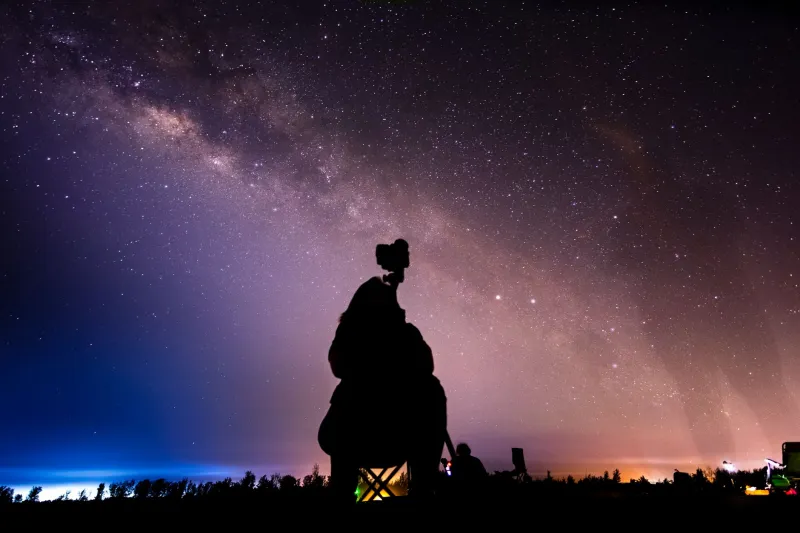
There's a romantic image of the lone astronomer — bundled up in a dark field somewhere in rural Montana, eye pressed to the eyepiece, communing silently with the cosmos. And look, there's nothing wrong with that. Solo stargazing has its own magic.
But here's the thing: if you want to get better at observing, the data suggests you probably shouldn't be out there alone.
Across astronomy clubs, online communities, and informal stargazing groups throughout the US, a consistent pattern keeps showing up. Observers who learn alongside other people — sharing views, swapping techniques, talking through what they're seeing — tend to develop their skills significantly faster than those who go it alone. And cognitive science has a pretty compelling explanation for why.
What the Research on Collaborative Learning Actually Says
Educational psychologists have studied collaborative learning across dozens of fields, from medical training to music performance. The findings are remarkably consistent: people who learn in social settings retain more information, correct errors faster, and build more flexible mental models than solo learners working through the same material.
The mechanism isn't complicated. When you explain something out loud to another person, you're forced to organize your own understanding. Psychologists call this the "protégé effect" — the act of teaching, even informally, deepens the teacher's own comprehension. Meanwhile, the person receiving the explanation gets a shortcut past trial-and-error learning that might otherwise take months.
Apply that to stargazing, and the implications are pretty significant. When an experienced observer stands next to a beginner and says, "See how you're tensing up around the eyepiece? Try relaxing your eye socket — let the image come to you" — that's not just helpful. It's the kind of feedback that could take a solo observer a full season to figure out on their own, if they ever do.
The Specific Skills That Develop Faster in Groups
Not every observational skill benefits equally from group learning, but several core competencies seem to accelerate dramatically in community settings.
Averted vision is a great example. This technique — looking slightly to the side of a faint object to engage the more light-sensitive rods at the edge of your retina — is genuinely hard to teach yourself. Many beginners stare directly at dim targets for weeks, frustrated that they can't see anything, without realizing the solution is to not look directly at the thing they want to see. One conversation with an experienced observer can solve that puzzle in about 90 seconds.
Star hopping is another. Navigating the night sky by moving from bright, recognizable stars to progressively fainter targets is a foundational skill, but building that spatial intuition takes time. Groups create natural opportunities to narrate the process out loud, which research suggests helps lock in the mental map more effectively than silent, solo practice.
Dark adaptation management — understanding how to protect your night vision, why red lights matter, how long adaptation actually takes — is the kind of knowledge that spreads almost virally through a group. One person learns it, shares it, and suddenly the whole group's observing improves.
What Community Leaders Are Seeing on the Ground
Astronomy club presidents and online community moderators across the country report strikingly similar patterns when they reflect on member progression.
The observers who show up consistently to group sessions — star parties, club nights, informal backyard gatherings — tend to progress through observational skill levels in roughly half the time compared to members who mostly observe solo and occasionally check in online. That's not a controlled scientific study, but it's a consistent enough anecdote to take seriously.
What seems to drive it isn't just the volume of information shared. It's the feedback loop. When you observe alone, you can go weeks reinforcing a bad habit without knowing it. In a group, someone notices. Someone asks, "Have you tried collimating your scope before you head out?" or "That eyepiece might not be the best match for your focal length." Those micro-corrections compound over time into a meaningfully better observer.
There's also something to be said for motivation. Showing up to a dark field alone on a cold November night in, say, Ohio requires a certain level of commitment that not everyone can sustain indefinitely. When there are people expecting you — when there's a shared excitement about what the group might see — the activation energy drops considerably. More sessions means more practice, and more practice means faster growth.
The Role of Collective Knowledge in Filling Individual Gaps
No single observer knows everything. Someone in your local club might have spent fifteen years tracking variable stars and can talk for an hour about photometry. Someone else might be a retired engineer who's become obsessed with telescope mechanics and can diagnose optical problems by looking at a star's diffraction pattern. A third person might have memorized every Messier object and can find M57 in under two minutes without a finder chart.
In a group, that knowledge is accessible to everyone. In isolation, each of those observers only has their own expertise.
Online communities extend this even further. Platforms where amateur astronomers share observation logs, post questions, and discuss technique create a kind of distributed intelligence that no individual can replicate. When someone posts a sketch of a galaxy they're struggling to identify and three experienced observers weigh in within an hour, that's a learning accelerant that simply didn't exist for previous generations of amateur astronomers.
How to Structure Group Sessions for Maximum Growth
If you're part of an astronomy club or a casual stargazing group and you want to be intentional about skill development, a few approaches tend to work well.
Designate a "teaching object" for each session. Pick one target — a globular cluster, a double star, a planetary nebula — and have everyone observe it independently before comparing notes. The discussion that follows is almost always more educational than the observation itself.
Encourage observation logs. Groups that normalize written or sketched records of what members see create a built-in accountability structure. Logs also make it easy to track improvement over time, which is motivating in its own right.
Mix experience levels intentionally. Resist the tendency for experienced observers to cluster together while beginners form their own group. The cross-pollination is where the real learning happens.
Talk through your process out loud. Even if no one asks, narrating what you're doing while you observe — how you're finding a target, what you're noticing, what's confusing you — invites input and reinforces your own understanding simultaneously.
The Bottom Line
The lone astronomer under a Montana sky is a great image. But if you want to become the best observer you can be, the evidence is pretty clear: you need people around you.
Communities don't just make stargazing more fun, though they absolutely do that. They create the conditions for faster learning, better feedback, and the kind of accumulated, shared knowledge that no individual can build alone. Whether that's a formal astronomy club, a loose group of neighbors with telescopes, or an active online forum, the community itself is a tool — maybe one of the most powerful ones available to any amateur astronomer.
Next time you're deciding whether to head out solo or wait for the next club night, it might be worth asking yourself: what would you learn if someone else were there?
Chances are, the answer is quite a bit.