Why You See More Stars When You're Not Looking Alone
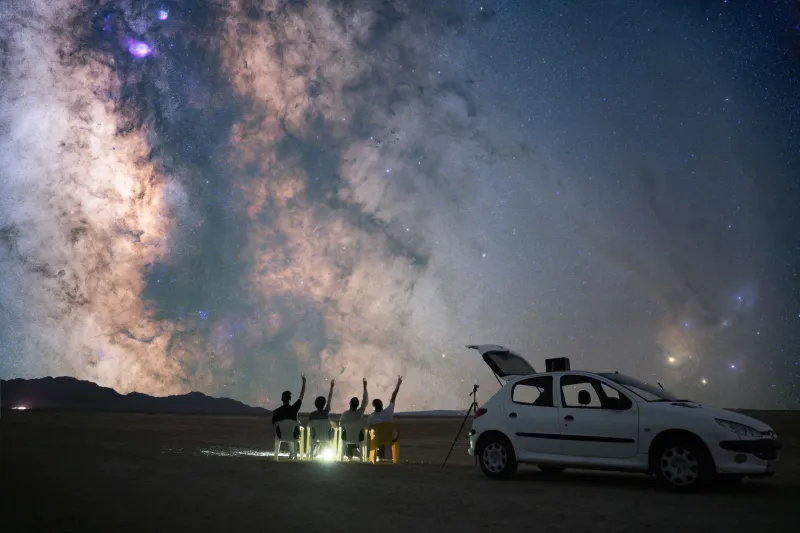
There's a moment that almost every seasoned stargazer can describe: you're out alone, scanning a familiar patch of sky, feeling pretty confident about what you're seeing — and then you show up to a group session and someone points out something you've walked right past a hundred times. A faint galaxy smudge. A double star hiding in plain sight. A satellite arc cutting silently across Orion's belt.
It's humbling. It's also kind of amazing. And it turns out, there's real science behind why it happens.
Your Brain Is Doing a Lot of Editing Up There
Here's something perception researchers have known for a while: human attention is selective, not comprehensive. When you look at the night sky alone, your brain is constantly making judgment calls about what deserves focus and what gets filtered out. It leans on pattern recognition — the constellations you already know, the planets you've tracked before, the brightness thresholds your eyes have learned to treat as meaningful.
That's useful, but it's also limiting. Cognitive scientists call this "inattentional blindness" — the tendency to miss things that fall outside your current focus, even when they're right in front of you. Solo stargazers are especially vulnerable to it because there's no external input to interrupt the mental routine.
Group observation changes that dynamic entirely. When five people are looking at the same patch of sky, five different attentional filters are running simultaneously. One person's peripheral glance catches a meteor. Another notices an unfamiliar color shift in a star they've been tracking. A third suddenly recognizes a faint asterism they'd never connected before. The group, collectively, sees more than any individual would on their own.
The "Point and Share" Effect
Member Sarah K. from an astronomy club in Colorado describes it this way: "I'd been looking at the Pleiades for years. I thought I knew it. Then someone in our group said, 'Can you see the nebulosity around Merope?' and I genuinely could not — until she pointed to it. After that, I couldn't unsee it. It's like the image unlocked."
That's not just a feel-good story. It reflects something real about how visual perception works. When someone verbally cues your attention — "look just below that bright one, slightly left" — they're essentially pre-loading your brain with a target. Your visual cortex then becomes more sensitive to stimuli in that zone. Scientists sometimes call this "top-down attention," and it dramatically improves detection of low-contrast or subtle features.
In practical terms: the person next to you at a star party isn't just pointing at something cool. They're temporarily upgrading your vision.
Expertise Is Unevenly Distributed (and That's a Feature)
One of the underappreciated strengths of group stargazing is that people bring wildly different knowledge bases to the same piece of sky. In any decent-sized astronomy group, you'll likely have someone who knows deep-sky objects cold, another who tracks double stars obsessively, a planetary observer who notices atmospheric banding on Jupiter that others dismiss as blur, and a newcomer whose fresh eyes catch things the veterans have stopped questioning.
That diversity isn't a complication — it's the whole point.
Mark T., a longtime member of an astronomy club in the Pacific Northwest, puts it bluntly: "The beginners in our group ask questions that force me to slow down and actually look at something I've been rushing past. They'll ask why that star looks orange, and I'll realize I haven't actually looked at it in years — I've just been identifying it."
This cross-pollination of expertise is one of the core reasons Astronomy Friends exists as a community, not just a content site. Observation skills compound when they're shared. The beginner learns to read the sky. The expert rediscovers wonder. Both leave having seen more than they came with.
How to Actually Leverage This at Your Next Group Session
Knowing the science is useful. Using it is better. Here are a few ways to deliberately build the "group perception" advantage into your next stargazing night:
Rotate observation targets as a group. Instead of everyone doing their own thing simultaneously, spend 10–15 minutes where the whole group focuses on one object. The conversation that emerges — what people notice, what they're unsure of, what surprises them — surfaces details that individual observation misses.
Encourage verbal descriptions before showing. Before someone points out what they're seeing, ask them to describe it in words first. This forces precision and often reveals that different observers are picking up genuinely different features of the same object.
Mix experience levels intentionally. Don't just cluster the veterans together. Pair a newer observer with someone who's been doing this for a decade. Both will benefit more than they expect.
Debrief after the session. Even a 10-minute wrap-up where people share what surprised them, what they couldn't figure out, or what they want to look up later dramatically increases retention — and often generates the best observations of the night, because people synthesize what they saw into something coherent.
Designate a "wide field" watcher. On nights with potential meteor activity or unusual atmospheric conditions, assign one person to keep their gaze broad and unfocused while others use eyepieces. They become your peripheral nervous system.
The Sky Gets Bigger With More Eyes
There's a reason that professional astronomy — even in the age of AI-assisted imaging and automated telescopes — still relies heavily on collaborative observation and peer review. The universe is too big, too subtle, and too surprising for any single perspective to catch everything worth catching.
Amateur astronomy is no different. The night sky rewards attention, and attention is one of those rare things that genuinely multiplies when it's shared. You're not just splitting up the workload when you stargaze with others — you're expanding what's perceptually possible for everyone in the group.
So the next time someone invites you to a local star party or a club observation night and you're tempted to say you'd rather go solo because it's "more peaceful" — consider what you might be leaving on the table. Or rather, up in the sky.
The stars aren't going anywhere. But some of them might stay invisible until someone else shows you where to look.